What a Verbal Fluency Test Is, and How the 60-Second Category Task Works
The One-Minute Task
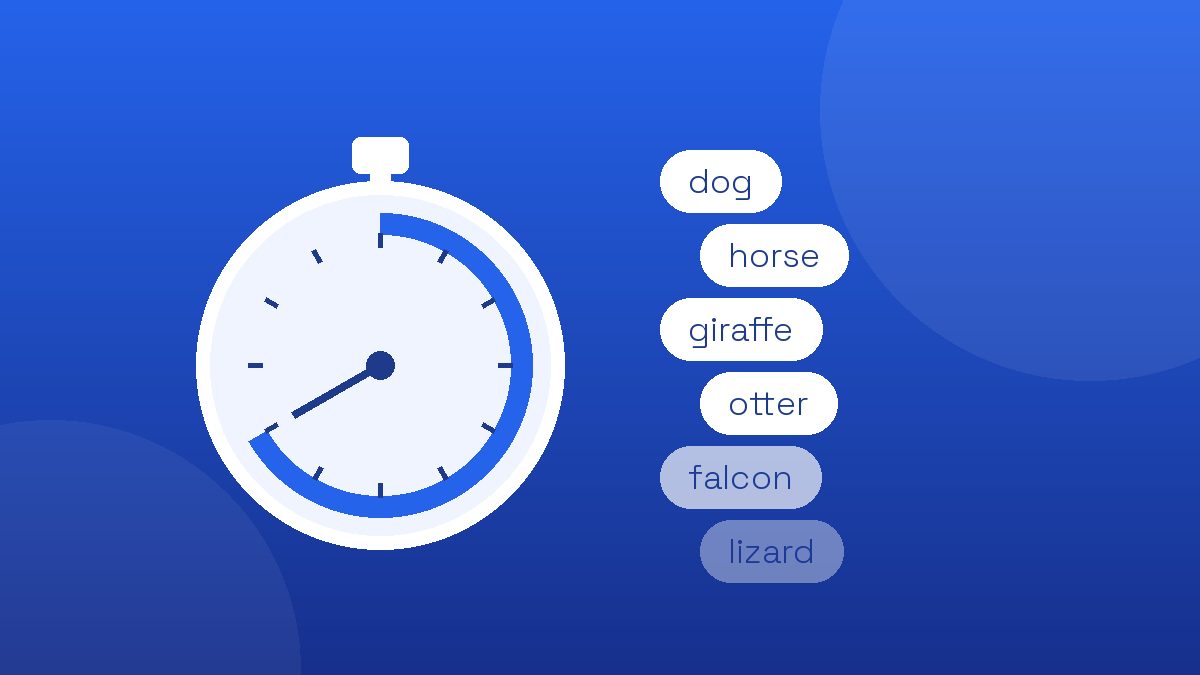
Someone starts a timer and says: name as many animals as you can in one minute. Dog, cat and horse come out fast. Somewhere around "giraffe" the list slows down, you start hunting, and the last twenty seconds feel long.
That is a verbal fluency test. It takes a minute to run, needs nothing more than a stopwatch and a pen, and turns up in research studies, memory clinics and short cognitive screening checks. Because it looks so simple, it is also easy to misread. A low count on a tired afternoon doesn't mean something is wrong with your brain, and a high count doesn't prove you're a good speaker.
This post covers how the test works, the difference between the category and letter versions, how researchers and clinicians score it, what a score can and can't tell you, and how to practice the task if you want to get quicker at pulling words on demand. It is general information, not medical advice. If you're worried about your memory or language, talk to a doctor.
The standard format is short. You get one rule and one minute. The rule is either a category, such as "animals" or "food and drink", or a starting letter, such as "words that begin with F". You say as many different words as you can that fit the rule, and the examiner writes them down. A team at the Max Planck Institute for Psycholinguistics describes it this way in a 2014 paper: one minute per task, and a score equal to the number of unique correct words (Shao et al., 2014).
One well-known pairing uses the letters F, A and S for one minute each (often called the FAS test) plus one minute of animal names. A normative study from Carleton University in Ottawa used exactly that pair with 1,300 cognitively healthy adults aged 16 to 95 (Tombaugh, Kozak & Rees, 1999).
Category Fluency vs. Letter Fluency
The two versions look alike, but they ask your memory to search in different ways.
Category fluency, also called semantic fluency, asks you to search by meaning. You know what an animal is and where animals live, so you can walk through pets, then the farm, then the ocean, then birds. Your knowledge of the world does a lot of the organizing for you.
Letter fluency, also called phonemic fluency, asks you to search by sound or spelling. That is an unusual way to look through your vocabulary. "Fork", "fiction" and "fault" share nothing except their first letter, so you have to hold the rule in mind, try different angles, and hold back the words that pop up but don't fit.
The two scores are related but not interchangeable. In the Carleton study, FAS totals and animal-naming totals correlated at r = .52, a moderate relationship. Education explained more of the variation in FAS scores (18.6%) than age did (11.0%). For animal naming the pattern flipped: age explained 23.4% and education 13.6% (Tombaugh et al., 1999).
Clinical research shows the split as well. A meta-analysis of 31 studies looked at people with damage to specific areas of the brain's outer layer. Damage to the frontal lobes went with large deficits on both letter and category fluency, of similar size. Damage to the temporal lobes went with a bigger deficit on category fluency than on letter fluency (Henry & Crawford, 2004).
A second meta-analysis, covering 153 studies and 15,990 participants, compared people with Alzheimer's-type dementia with healthy controls. The dementia group was more impaired on category fluency than on letter fluency. The authors read this as a sign that the store of word meanings itself is affected, beyond a general problem with effortful searching (Henry, Crawford & Phillips, 2004).
Those are group averages from people who already had a diagnosis. They explain why researchers give both versions. They don't let anyone diagnose a single person, including themselves, from one score. If you want the background on how the brain looks up words in the first place, our post on the neuroscience of word retrieval walks through it.
How the Test Is Scored
The basic score is a count of correct, unique words. In the Shao study, for example, participants were asked to avoid names of people and places and to avoid repeating words, and repetitions and proper names were left out of the count (Shao et al., 2014). Exact rules differ between protocols, so if you're looking at a score from a clinic, the clinic's scoring sheet is the authority.
A raw count means little on its own. It gets compared with people of a similar age and education level. That's why the Carleton norms are split into three age bands (16 to 59, 60 to 79, 80 to 95) and three education bands (0 to 8, 9 to 12, and 13 to 21 years of schooling). The same count can be ordinary for one person and low for another.
Clustering and switching
Researchers often look past the total at how the words came out. In a 1997 study at the Rotman Research Institute in Toronto, Troyer, Moscovitch and Winocur proposed two parts to the task (Troyer et al., 1997):
- Clustering: producing a run of related words inside one subcategory, such as pets, or words starting with "fl".
- Switching: moving on to a new subcategory when the current one runs dry.
An animal list might look like this: dog, cat, hamster, goldfish (pets), then cow, pig, sheep, goat (farm), then shark, whale, octopus (sea). That's three clusters and two switches.
In their data, both clustering and switching tracked the total closely on category fluency. On letter fluency, switching mattered more than clustering. When young adults had to do a second task at the same time, they produced fewer words and switched less, but only on the letter task. The authors concluded that clustering and switching are separate components and linked switching to frontal-lobe functioning.
Examiners also notice repeated words and words that break the rule. Keeping track of what you've already said, and ignoring words that don't fit, is part of what the task demands.
What a Score Can Tell You
A fluency score reflects more than vocabulary. Shao and colleagues tested 82 older adults on vocabulary size, lexical access speed (how quickly they could name things), updating (keeping track of information in working memory) and inhibition (holding back unwanted responses). The number of words people produced on both tasks was predicted by updating ability. How fast the first word came out was predicted by vocabulary size and, for category fluency, by lexical access speed. The authors described the tasks as having a "hybrid character", and noted that this may limit their usefulness for research and clinical purposes (Shao et al., 2014).
So a score mixes several things: how many words you know, how fast you can get to them, and how well you run the search while keeping track of the rule. In research, where results are averaged across many people, that mix is useful. Comparing category and letter scores, and looking at clusters and switches, can hint at which part of the process is struggling.
For an everyday speaker, the task is a decent mirror for one specific skill: pulling words out of memory under time pressure. That skill shows up in daily life when a word you know well won't come in a meeting. We cover that experience in why you forget words mid-sentence.
What It Can't Tell You
It is not a diagnosis. The Alzheimer's Association describes brief cognitive tests as screening tools that identify people who may need additional evaluation. For a definitive diagnosis of mild cognitive impairment or dementia, it says people who fail a screening test should be evaluated further or referred to a specialist (Alzheimer's Association).
A 2022 paper in the American Journal of Geriatric Psychiatry makes the same point from the research side. Diagnosing with a brief screening tool can lead to both false positives and false negatives, especially when only one test is used. A full neuropsychological evaluation, which the authors call the gold standard, typically involves hours of testing across several areas of thinking, and the results are read alongside a person's first language, years of education, health, medications and reports from people who know them (Weinstein et al., 2022).
A home score has no norms behind it. When you time yourself in the kitchen, nobody adjusts the number for your age, schooling or first language, and the Carleton data show that age and education both move the totals. If English is your second language, your English score and your score in your first language can differ for reasons that have nothing to do with brain health.
One minute is a small sample. A single round can swing with the category you picked or whether a good cluster occurred to you early.
It says little about how well you talk. The test asks for single words. It doesn't measure whether you can organize an argument, tell a story with a clear point, or explain an idea to someone who disagrees with you.
If you or someone close to you has noticed changes in memory or language that worry you, take that to a doctor rather than to a stopwatch. Our post on verbal fluency and cognitive health has more background on why researchers study this link.
How to Practice the 60-Second Task
If your goal is to get quicker at finding words, the fluency task makes a good daily drill. A few ways to make the practice worth the minute:
Record it and count afterwards. Open your phone's voice recorder, pick a category or a letter, and talk for 60 seconds. Counting while you speak slows you down, so count when you play it back. Use the same rules each time: no repeats and no names of people or places.
Rotate categories and letters. Scores go up when people repeat a test. A meta-analysis of nearly 1,600 effect sizes from neuropsychological tests defines these practice effects as score increases caused by things like remembering specific items, learned strategies and familiarity with the test (Calamia, Markon & Tranel, 2012). If you name animals every morning for a month, part of your rising score will be a memorized animal list. Switching between categories (tools, things in a kitchen, jobs, things that are cold) and letters (B, M, T, P) keeps the search fresh.
Cluster on purpose, then switch. Using Troyer's two components as a method, work through one subcategory until it slows, then jump to the next one without waiting. On a letter round, try sound families: "fl" (flag, flute, flinch), then "fr" (frost, friend, fraction), then "fi" (fiddle, figure, final). We haven't found good evidence that training this habit improves everyday speech, so treat it as a way to make practice less frustrating, not a guaranteed upgrade.
Turn three words into a sentence. After a round, pick three words from your list and use them in one spoken sentence. It moves the practice from single words toward real speech. Our list of exercises to improve verbal fluency has more drills that work this way.
Feed the store. A round can only pull out words you already know. Reading widely and trying new words out loud adds to what's available; our post on expanding your vocabulary covers how.
If you'd like this built into a daily routine, Flowency's training includes category drills and sound-based word drills. Word Gym has rapid word-retrieval drills, and the five-minute Daily Workout mixes word drills with sentence rephrasing and short speaking challenges.
Key Takeaways
- A verbal fluency test asks you to say as many words as you can in one minute that fit a category (animals) or a starting letter (F).
- Category fluency searches by meaning. Letter fluency searches by sound and leans harder on holding a rule in mind.
- The score is the number of unique correct words, compared against people of similar age and education. Researchers also look at clustering and switching.
- A score mixes vocabulary, speed of access and working memory. It is a screening and research tool, not a diagnosis.
- To practice, record yourself, rotate categories and letters, cluster then switch, and turn your words into sentences.
- If you're worried about memory or language changes, see a doctor.
Sources
- Shao Z, Janse E, Visser K, Meyer AS. What do verbal fluency tasks measure? Predictors of verbal fluency performance in older adults. Frontiers in Psychology, 2014.
- Tombaugh TN, Kozak J, Rees L. Normative data stratified by age and education for two measures of verbal fluency: FAS and animal naming. Archives of Clinical Neuropsychology, 1999.
- Troyer AK, Moscovitch M, Winocur G. Clustering and switching as two components of verbal fluency. Neuropsychology, 1997.
- Henry JD, Crawford JR. A meta-analytic review of verbal fluency performance following focal cortical lesions. Neuropsychology, 2004.
- Henry JD, Crawford JR, Phillips LH. Verbal fluency performance in dementia of the Alzheimer's type: a meta-analysis. Neuropsychologia, 2004.
- Calamia M, Markon K, Tranel D. Scoring higher the second time around: meta-analyses of practice effects in neuropsychological assessment. The Clinical Neuropsychologist, 2012.
- Weinstein AM, Gujral S, Butters MA, et al. Diagnostic precision in the detection of mild cognitive impairment: a comparison of two approaches. American Journal of Geriatric Psychiatry, 2022.
- Alzheimer's Association. Cognitive screening and assessment.
Practice Finding Words Faster
Flowency's Word Gym and five-minute Daily Workout give you category and sound-based word drills plus short speaking challenges. Try it free for 3 days.

